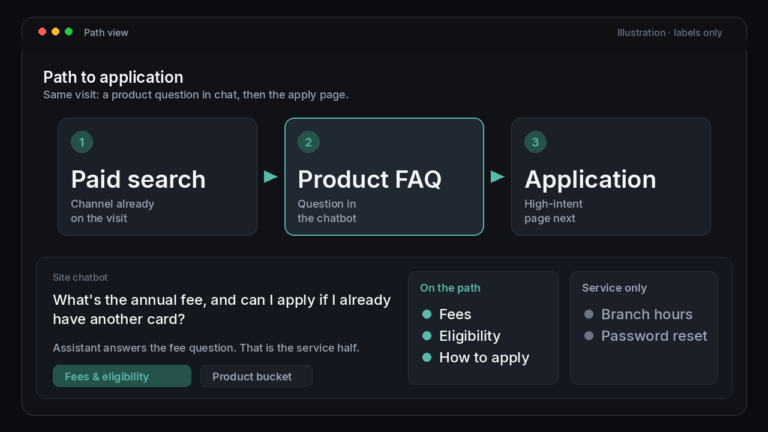

I ran this PoC around a business question that keeps coming up when new models appear for marketing data: on Meridian’s own demo table, can a table-focused foundation model do the planner’s job for next year’s media mix, or does it mainly forecast the KPI once a spend plan is already assumed?
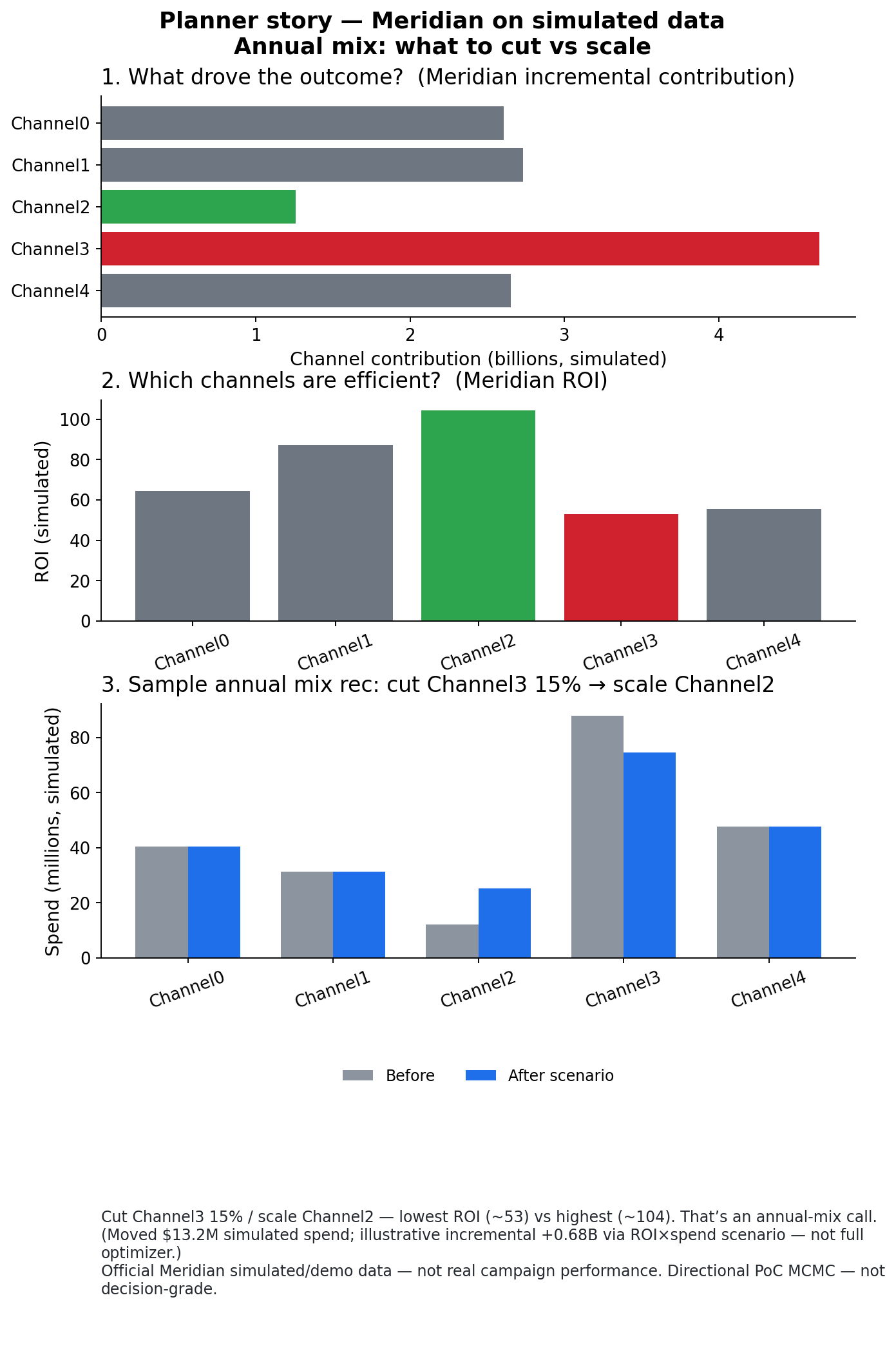
In practice, those two asks are easy to confuse. The first is “if we keep spending like this, what might results look like?” The second is “what should we cut, and what should we scale next year?” Annual planning lives in the second question. A forecast only becomes useful after someone has already assumed the spend plan, whereas marketing mix modeling is built to support reallocation through channel contribution, ROI, and a cut-versus-scale story a planner can argue with.
So the success bar for calling TabFM an “MMM alternative” was not a closer error score on holdout weeks. It was whether TabFM could feed that cut/scale path on the same clean table. One fair perspective from this run is that TabFM’s KPI forecast is not bad versus Meridian on level-error metrics (MAPE/MAE) for the same holdout window — the relative gap was modest (roughly mid-single-digit MAPE for both), even though absolute errors look large on a high-base conversion series. Treat that as forecast closeness on this window under light specs on both sides, not overall model quality (other fit measures such as R² showed a wider gap), and not a claim that the absolute error is “small.”
The code and planner visuals are here: github.com/anthony-tsui/tabfm_mmm_poc
What I tested
I compared Google’s Tabular Foundation Model path with Google Meridian on Meridian’s official simulated/demo data, using the same input shape a planner would expect: time, channels, controls, and KPI. That stable channel spend and KPI table is the shared input. Both tools can read it; of the two, only Meridian turns it into mix recommendations.
No Meridian-grain spend+KPI table → no cut/scale, and TabFM isn’t a shortcut around that pipeline.
This was a bounded experiment rather than a production MMM rollout. Meridian here used a light MCMC setup on purpose (national data, small chains / keep), so the cut/scale numbers are a directional demo rather than decision-grade posteriors. TabFM in this run was zero-shot in-context learning with no fine-tune. On ask 1 (KPI forecast), both setups were light-spec — more Meridian tuning (chains, burn-in, priors, possibly geo) and a stronger TabFM setup (context design, ensemble, or adaptation) could shrink KPI error further. That still does not unlock ask 2. Numbers are illustration on demo data rather than advice for a real brand. The fair comparison was the same decision on the same input table, not whether the two systems belong to the same model family.
What the planner sees
On this run, Meridian produces contribution and efficiency outputs that support a labeled mix story — cut Channel3 and scale Channel2 — with the important caveat that this is a demo from light MCMC, not a production plan.
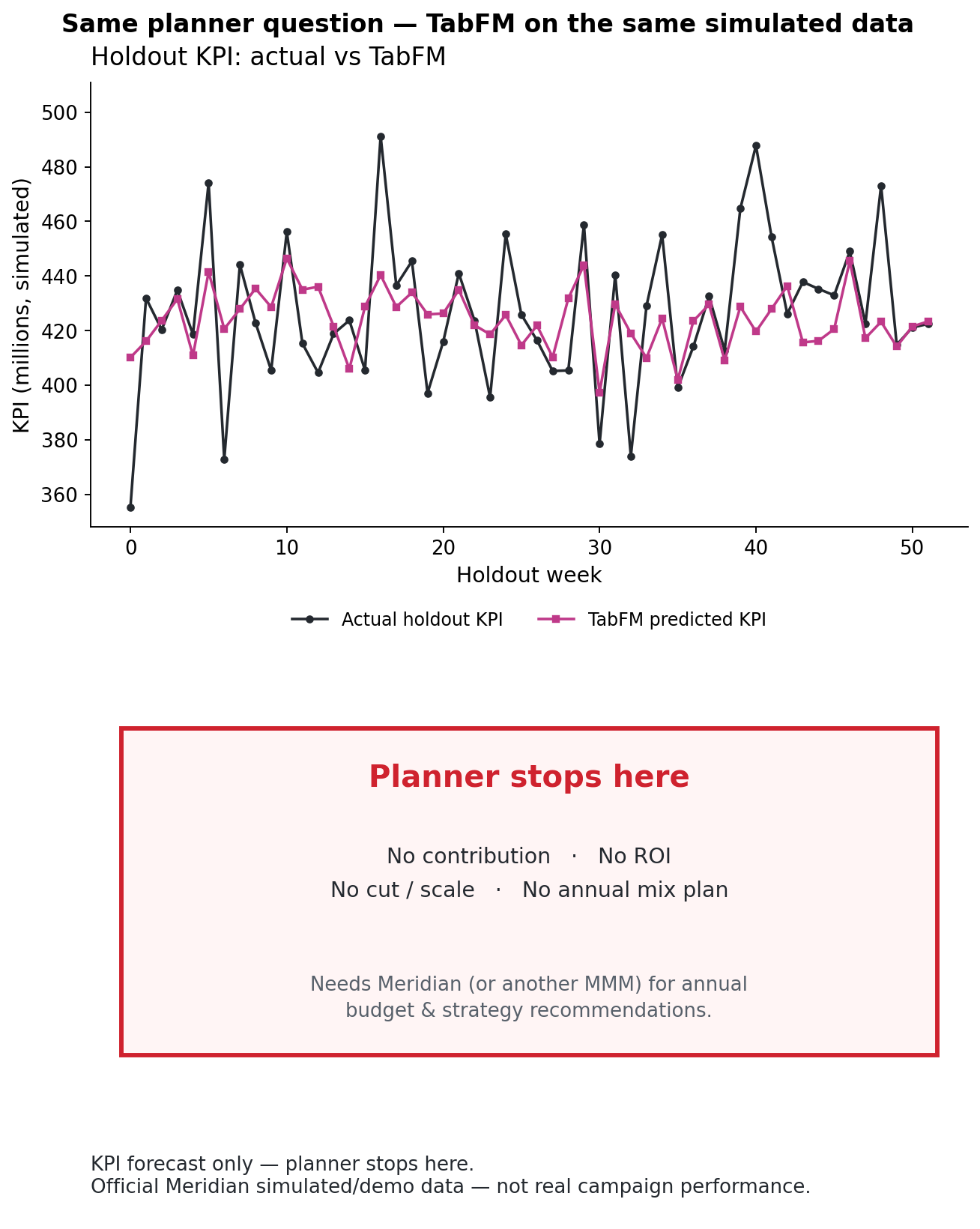
On the same data, the table-focused model stops at a KPI forecast. That is a useful signal for interim monitoring, but it is not a media plan.
When the two forecast lines are overlaid on the shared holdout, TabFM does not look weak next to Meridian.
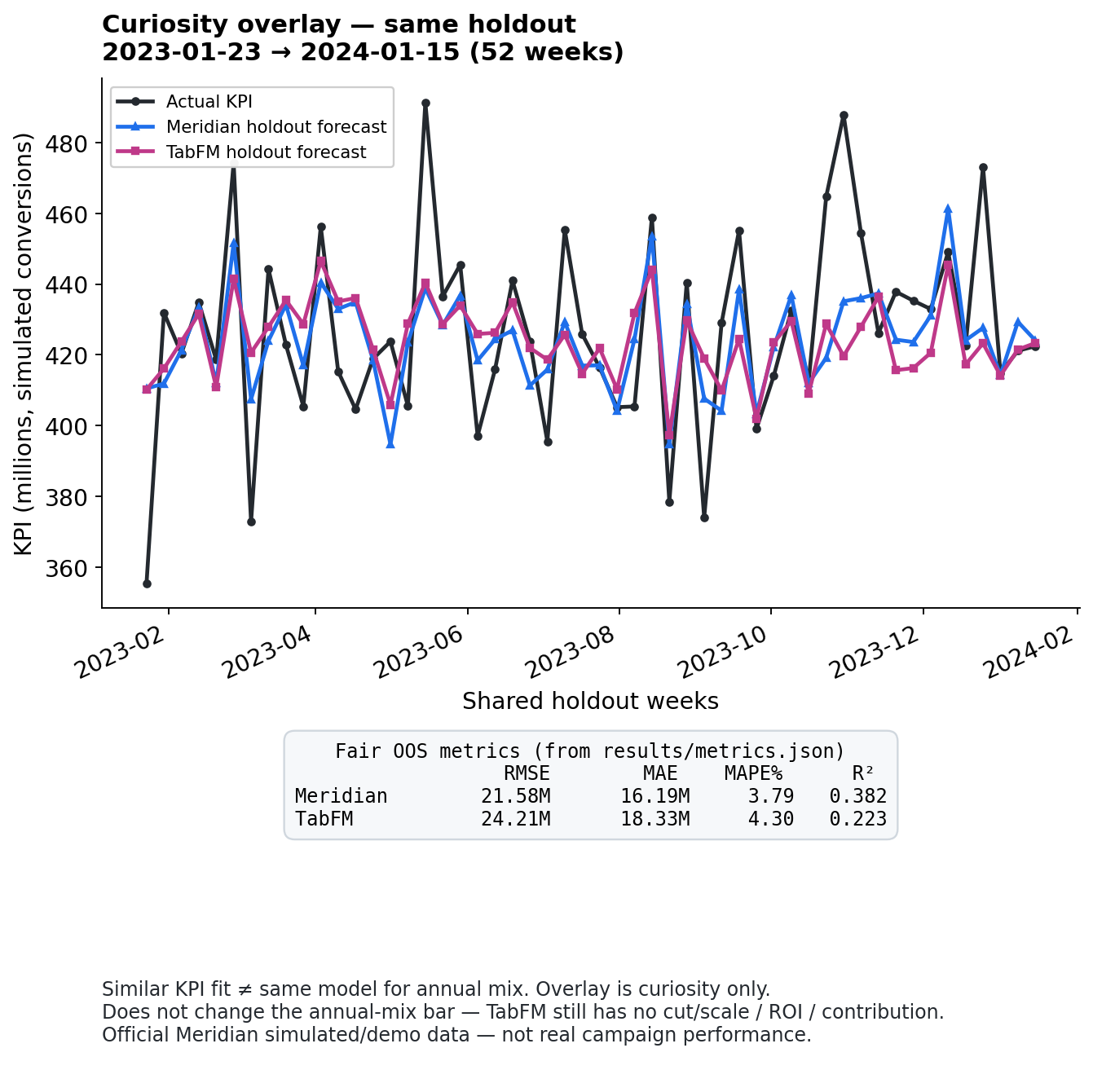
On this holdout, TabFM’s KPI forecast can look competitive with Meridian’s on level-error (MAPE/MAE), which is a useful perspective for teams that want a faster interim forecast helper. That is not a claim about overall model quality — R² was a wider gap — and close level-error still does not hand you a cut/scale recommendation.
How I’d use the tools
I would keep marketing mix modeling for contribution, ROI, and cut-versus-scale decisions on a planning cadence, and treat a table-focused model as an optional helper for interim KPI forecasts only after the spend plan already exists. Feature importance and ablation hacks should not be treated as incremental contribution, because that recreates the false parity this PoC is trying to avoid.
That dual view points to a simple ownership split for a marketing team: Planning owns MMM for annual mix — the cut/scale decisions that hit the budget — while always-on analytics can use a table-focused model for interim KPI forecasts once that plan exists. The business outcome is fewer wrong-tool bets, a cleaner handoff between plan and forecast, and less false confidence in next year’s media budget — not a shinier accuracy chart.
What this is not
This is not an argument that AI is useless for marketing measurement, that Meridian is the only MMM, or that the PoC was a bake-off to be won on error metrics. Forecast helpers and budget tools answer different stakeholder questions, and mixing them up creates false confidence in the annual plan.
Teaching a model to copy Meridian outputs would still need an MMM or another causal layer to label new years and markets. That is an emulator story rather than a replacement story, and I left it out of scope on purpose.
Closing
Can a table-focused foundation model replace marketing mix modeling for next year’s media budget? On the planner evidence from this PoC, the honest answer is no for cut/scale, while a second fair perspective is that TabFM’s KPI forecast can be competitive on this demo once the spend plan exists. Competitive forecast fit on Meridian’s table is interesting; it is not an annual mix recommendation.
That matches the thread across my other PoCs: use AI to speed repetitive preparation and first-pass analysis, and keep experts responsible for interpretation and consequential decisions.